Making a New Friend
How acquaintances gradually become friends: saying hello, finding something in common, and spending time together.
 Social Stories.
Log in
Social Stories.
Log in
THE STORY COLLECTION
Friendship, feelings, and finding the words. Explore stories about the situations that shape everyday life.
Read a sample story ↗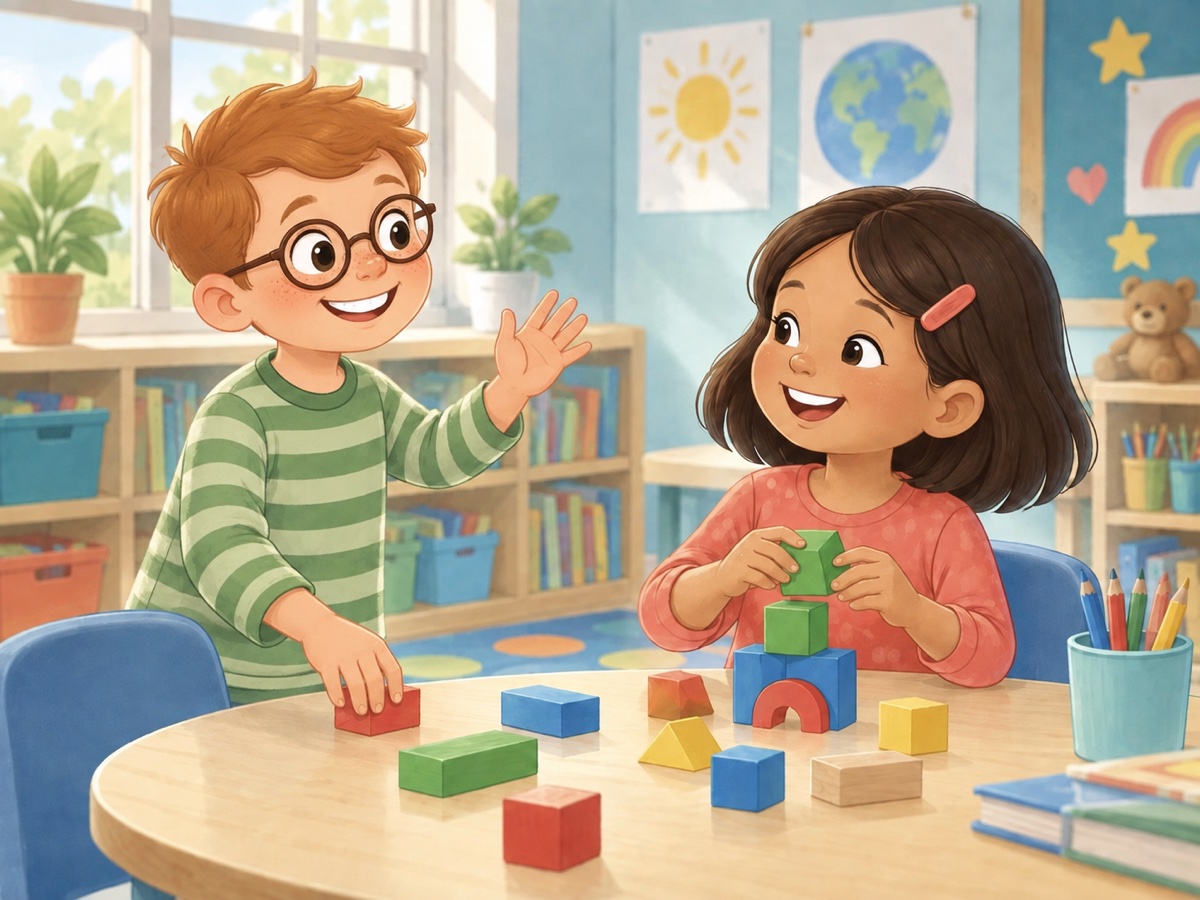
Find a familiar situation.
Start a conversation together.
FIND A STARTING POINT
67 story topics across 3 categories
How acquaintances gradually become friends: saying hello, finding something in common, and spending time together.
What to do when other children are already playing or talking and I want to participate.
Inviting another child to an activity and handling either yes or no.
A “no” doesn't necessarily mean they dislike me; what I can do next.
Friends don't always choose my preferred game; taking turns choosing activities.
Talking about something I love while checking whether the other person wants to keep talking about it.
Friendship involves discovering what another person likes too.
Turns in games, activities, choosing things, and conversation.
Winning and losing without friendship depending on the result.
Disappointment is okay; the game ending isn't the same as something bad happening.
Someone else's success doesn't take something away from me.
Friends can have other friends without ending our friendship.
What exclusion can feel like and choices for responding or seeking support.
Someone may want to be alone without being angry with me.
Notice, ask, listen, and offer help—while understanding that I may not be able to fix it.
Understanding impact, checking what happened, apologizing, and repairing.
Saying what bothered me, asking them to stop, and getting help if needed.
Friends can disagree or get angry and still remain friends.
Distinguishing joking, teasing, mistakes, repeated unkindness, and bullying.
Mutual interest, kindness, trust, and wanting to spend time together—not simply someone saying, “I'm your friend.”
Friends can say no, have privacy, want space, and spend time apart.
Calming down, understanding what happened, talking, and deciding what comes next.
Feelings are normal and aren't inherently good or bad.
Recognizing feelings such as happiness, sadness, anger, worry, excitement, embarrassment, jealousy, and disappointment.
Heart rate, tense muscles, a hot face, stomach sensations, energy level, and other clues.
Noticing escalation before becoming completely overwhelmed.
What anger feels like and safe things I can do while angry.
What happens when something isn't working or is harder than expected.
Recognizing uncertainty and ways to ask questions or seek reassurance and support.
Too much noise, activity, information, or emotion; reducing demands and getting somewhere calmer.
Mistakes and awkward moments happen to everyone and usually pass.
Wanting something another person has without needing to act against them.
Something can be important to me and still not happen.
The difference between something feeling unfair and knowing what response will help.
Disappointment, uncertainty, and alternatives after hearing no.
Understanding what I'm waiting for and what I can do while I wait.
Expected versus unexpected events and creating a new plan.
Mistakes provide information; what I can do next instead of getting stuck on the mistake.
Recognizing when I need one and communicating that need.
Different strategies work for different people: space, movement, sensory tools, music, breathing, or support from an adult.
A break has a beginning and an end; deciding when and how to rejoin.
Their feeling may not be caused by me, and I don't necessarily need to solve it.
Greetings, comments, and questions as different ways to begin.
Using shared situations, shared interests, and things I know about the other person.
Asking questions and learning things gradually rather than needing everything at once.
Conversation usually moves back and forth.
Listening doesn't require eye contact; showing someone I'm following in ways that work for me.
Holding the thought, finding a pause, or asking to interrupt when necessary.
When interruption is okay, urgent, or unnecessary.
Sharing enthusiasm while leaving room for the other person's interests.
Noticing words, pauses, responses, changes of subject, and body orientation—and asking when uncertain.
Conversations naturally move between topics.
It's okay to pause, say “I don't know,” ask a question, or end the conversation.
Ways conversations normally finish without either person being upset.
Different relationships can have different expectations and topics.
Finding an opening when several people are talking.
Group conversation can be messy; it isn't necessarily deliberate exclusion.
Volume depends on the environment rather than one universally “correct” voice.
Asking them to repeat, explain, or say it another way.
Trying again, writing, drawing, showing, or asking for help communicating.
Directly communicating needs rather than assuming others already know.
Who to ask, what information to provide, and what happens next.
I can disagree without either person necessarily being wrong or bad.
Giving enough information so another person can understand what happened.
Why people sometimes don't literally mean their words and how to ask when unsure.
Avoiding assumptions, noticing information, and checking with the person when appropriate.
Other people only know what I've communicated; a foundational perspective-taking story.
Classroom routines, participating in learning, and finding support during the school day.
Preparing for unfamiliar places, unexpected changes, and new experiences.
Understanding sensory needs and communicating what feels comfortable.
Personal space, saying no, recognizing boundaries, and asking a trusted adult for help.
Everyday routines, relationships, and shared experiences at home.
Getting familiar with outings, appointments, and places in the community.
No matching story topics. Try another word or clear your search.
Explore stories for communication, choice, and familiar routines.
Stories in ABA settings ↗